
One Identity Manager — the story
Today’s post is the first in a series dedicated to different aspects of IGA, IAM, and PAM solutions. We’re starting on a lighter note by walking you through the history of One Identity Manager — a solution we successfully implement and develop for our clients.
One Identity Manager — the story
My first encounter with the solution now called One Identity Manager was in 2013. Back then, the product still operated under the name Quest One Identity Manager (the spelling varied across materials, but “Quest” was the key part). The version I worked with at the time was 6.1, and even then it already had several really solid features out of the box.
One example was the native approach to primary and secondary identities, which can significantly simplify scenarios such as multi-contract employment, different account types (e.g., standard vs. privileged), or accounts with different entitlement sets within the same organization. It’s one of those elements that makes a real difference in practice because it brings order to both the model and downstream processes.
What came before “One Identity Manager”?
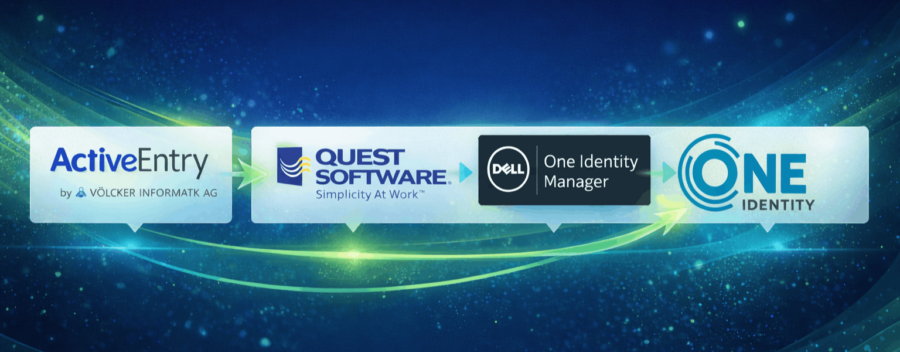
The “Quest” name came from Quest’s acquisition of the German company Völcker Informatik AG — the original creator of software known as ActiveEntry. Völcker Informatik AG had been operating in Berlin since 1995, and ActiveEntry was built as a solution for automating identity and access management in organizations. The core team behind One Identity Manager still develops the system in the Berlin office.
The acquisition by Quest was announced on July 12, 2010, and that was when ActiveEntry effectively became part of the Quest One IAM portfolio.
A historical side note: ActiveEntry (and therefore the roots of One IM) was already maturing before Microsoft released its well-known IDM products. MIIS 2003 reached RTM on July 2, 2003, and FIM 2010 licensing started on May 27, 2010.
Quest… or Dell?
It gets even more interesting from there, because Quest itself was acquired by Dell. The deal was announced on July 2, 2012, and the formal “Quest is now part of Dell” communication came in late September 2012. In practice, rebranding from Quest to Dell took some time (which is why in 2013 you could still see the old naming), but eventually the product operated as Dell One Identity Manager.
During that period, a major shift came with version 7.0, where there was a clear quality and modernization leap. I won’t pretend it was a completely new platform, but there was visible, substantial work: changes and improvements in the database schema, better approaches to data consistency, and further development of the standard web portal (support materials explicitly show this as a key development focus for “Dell One Identity Manager 7.0”).
Dell… or Quest again?
In 2016, Dell sold the Dell Software Group (including Quest and SonicWall). The transaction close was announced on November 1, 2016 by Francisco Partners (in consortium with Elliott Management), and this was also when they openly talked about establishing two companies: Quest and SonicWall.
At the same time, Dell was also closing its huge merger with EMC (transaction close: September 7, 2016), and it’s worth remembering that Dell also had other security “toys” in the group, including RSA as part of Dell Technologies after that transaction.
And importantly: One Identity Manager was not cut just because there were other security products in the group. The product line stayed alive and continued to evolve (in my view, sometimes too conservatively — but it did evolve).
Who owns One Identity Manager today?
Today, One Identity Manager is part of One Identity’s portfolio (One Identity LLC), and One Identity operates as an independent brand under the Quest umbrella (this wording appears directly in One Identity communications).
If the question is “which fund owns it?” — the key is who controls Quest. Quest stated that Clearlake Capital Group finalized the acquisition of Quest on February 2, 2022.
What’s next?
This post is intentionally historical and fairly light — because before we dive into architecture and more technical topics, it helps to know where this product came from and why its name changed so many times along the way.
This is the first article in our One Identity Manager (One IM) series on our blog. In upcoming parts, I’ll go much more technical, and I hope it will be an interesting read and a useful source of knowledge for anyone interested in IGA-class systems.